

Neuro® San
Open-Source Multi-Agent Framework
Build, test, and orchestrate multi-agent systems with an open-source framework designed for flexible agent collaboration

OVERVIEW

CASE STUDY
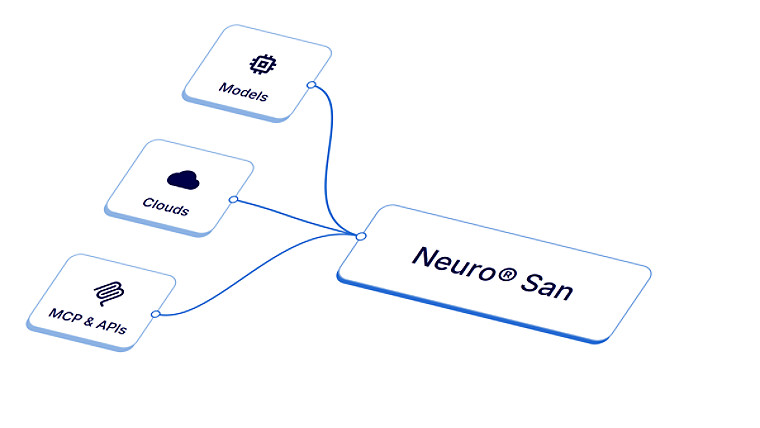
Powering One of the Largest Enterprise Multi-Agent Systems
Powered by Neuro San, Cognizant's unified digital workplace connects more than 200 specialized agent capabilities to support 350,000 employees, streamline access to enterprise services, and reduce support tickets by 50%.
DIFFERENTIATORS
What Sets Neuro San Apart from other Multi-Agent Frameworks? ?
Explore how Neuro San compares with other multi-agent frameworks, from natural-language agent creation and dynamic orchestration to built-in security, testing, and deployment flexibility.
Feature | Neuro San | CrewAI | LangGraph | Agno | PydanticAI | Google ADK |
|---|---|---|---|---|---|---|
Adaptive communication | ✓ | ⚠️ | ⚠️ | ✓ | ⚠️ | ✓ |
Configuration-driven networks | ✓ | ✓ | ✕ | ✕ | ⚠️ | ✕ |
Private data handling | ✓ | ✕ | ✕ | ✕ | ✓ | ✓ |
Dynamic network creation | ✓ | ✕ | ⚠️ | ⚠️ | ✓ | ✓ |
Built-in testing & validation | ✓ | ✕ | ✕ | ⚠️ | ✓ | ✓ |
Observability & logging | ✓ | ⚠️ | ⚠️ | ✓ | ✓ | ✓ |
CAPABILITIES
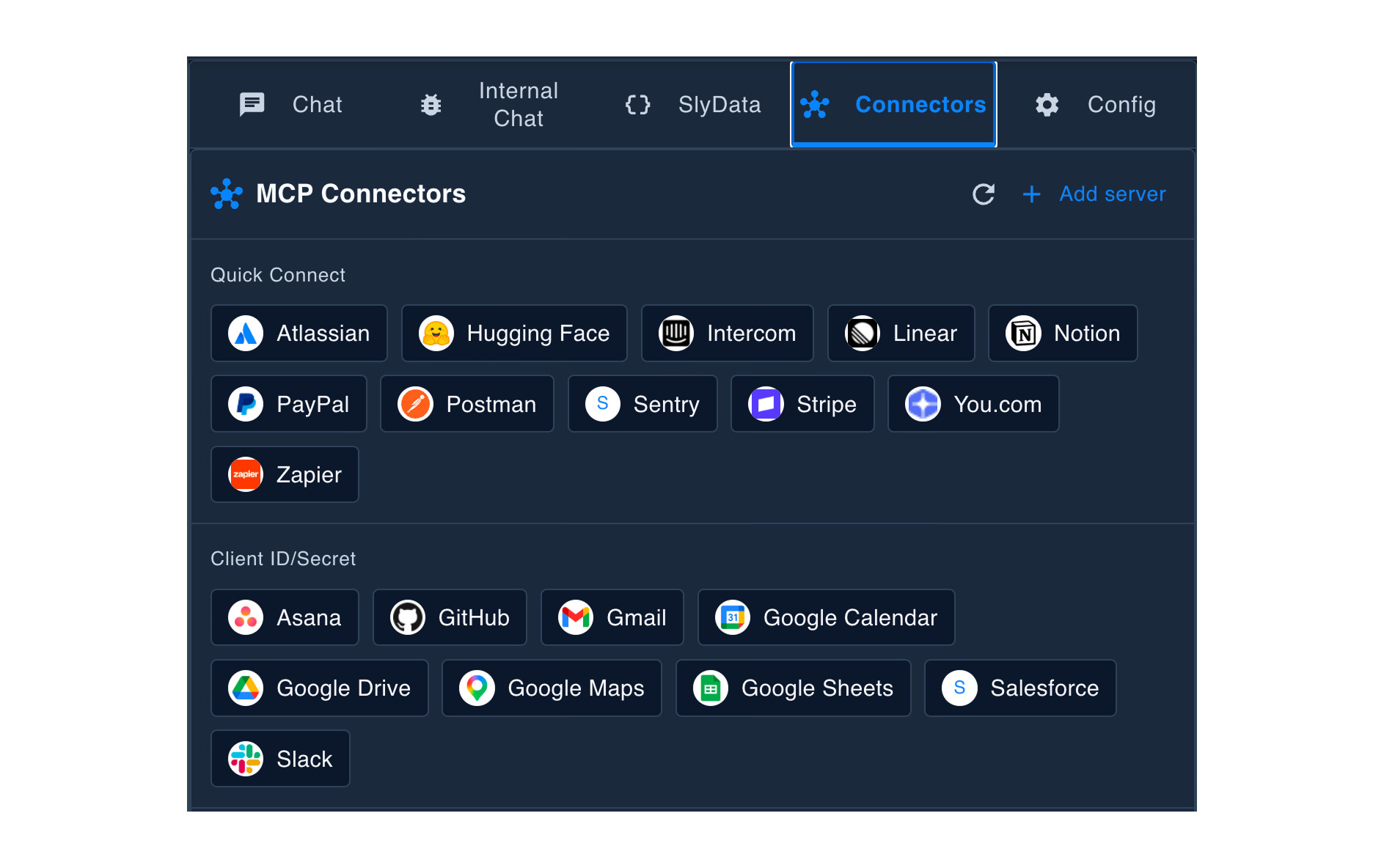
Core capabilities of Neuro San
DEMOS
See What You Can Build with Neuro San
Start with ready-to-use agent networks you can run, inspect and modify for real-world use cases.
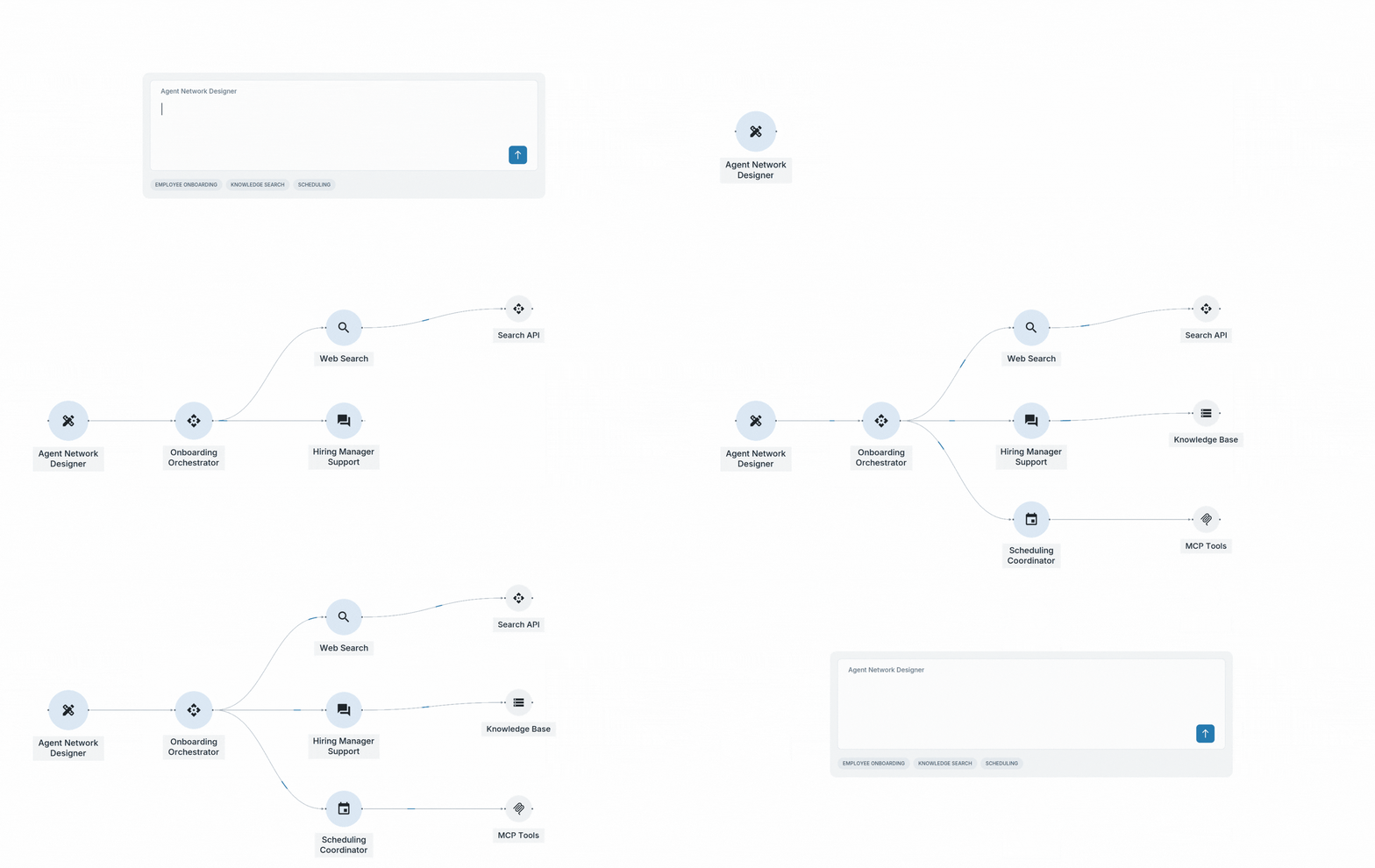
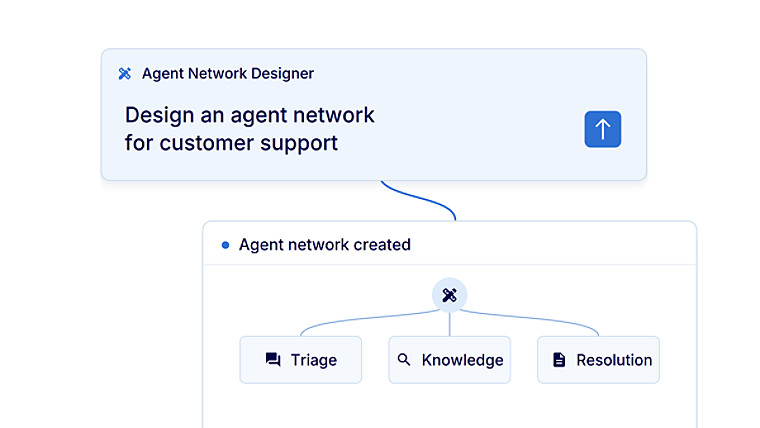
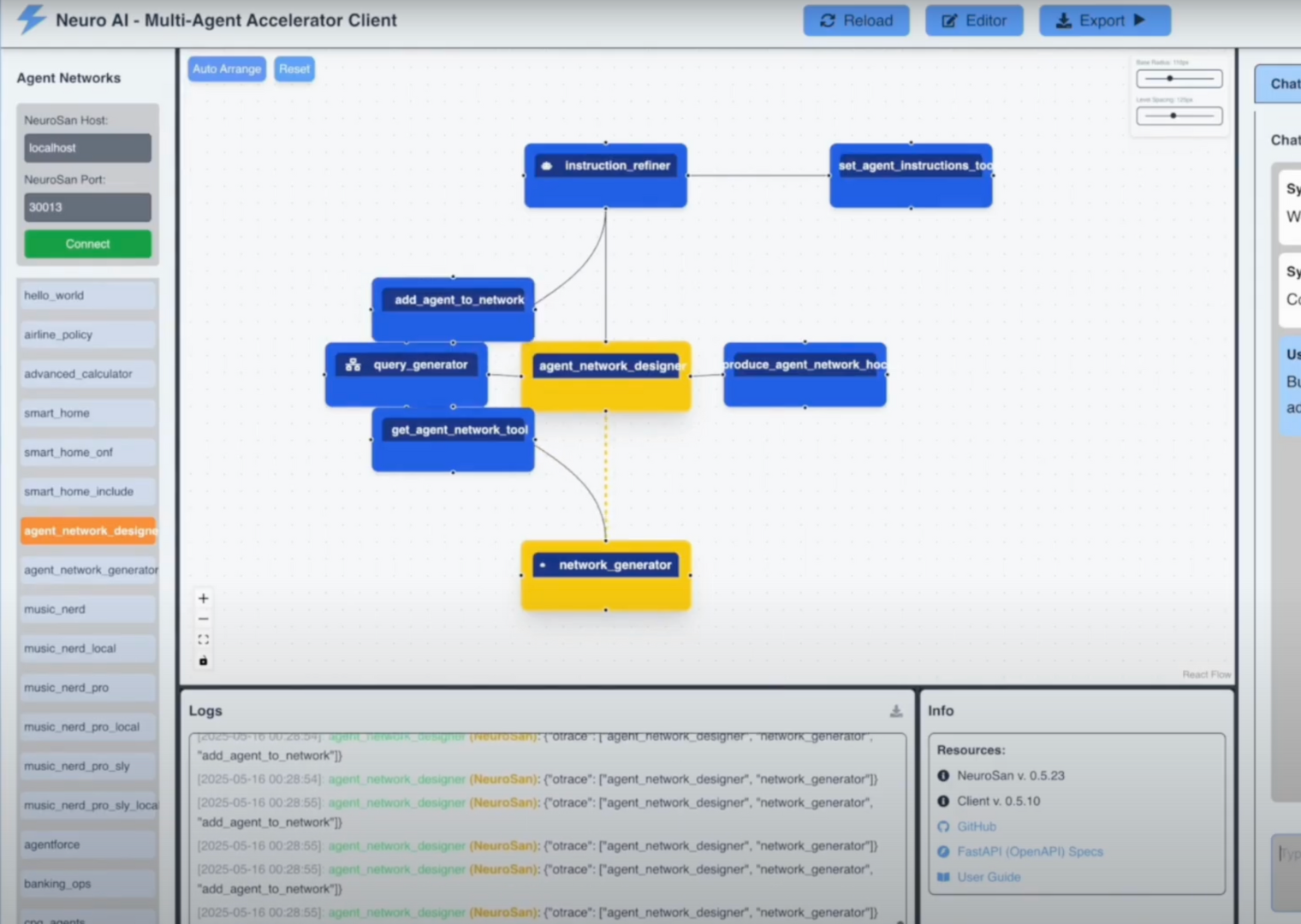
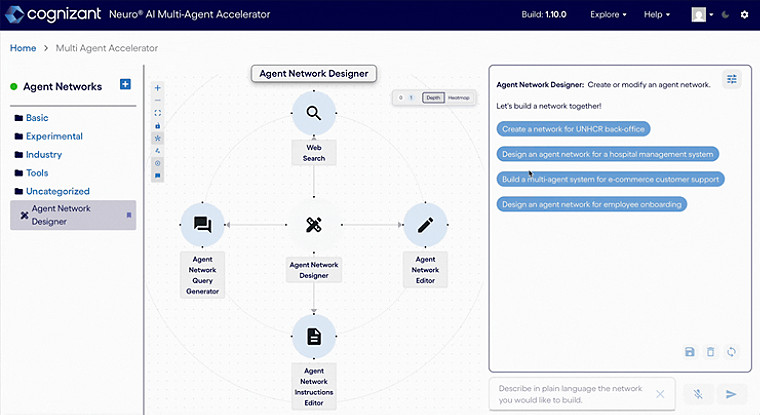
A network to create multi-agent systems. Describe an organization or use case, and the Agent Network Designer automatically generates a multi-agent system, complete with a HOCON configuration file, saved network definitions in your registries, and examples of how to use it.
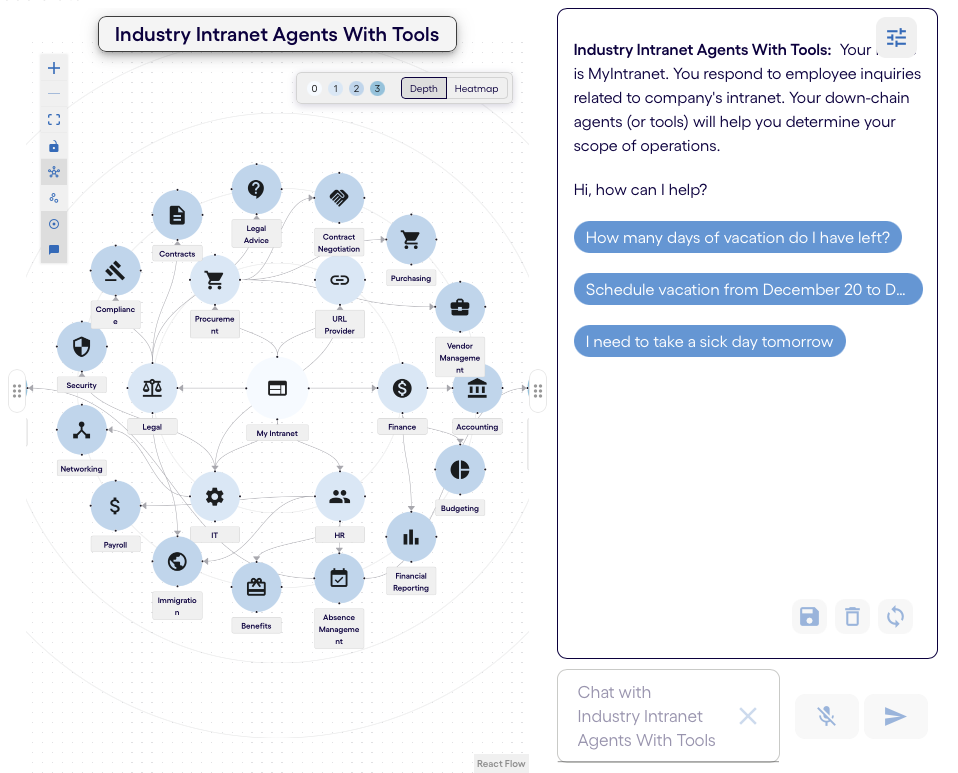
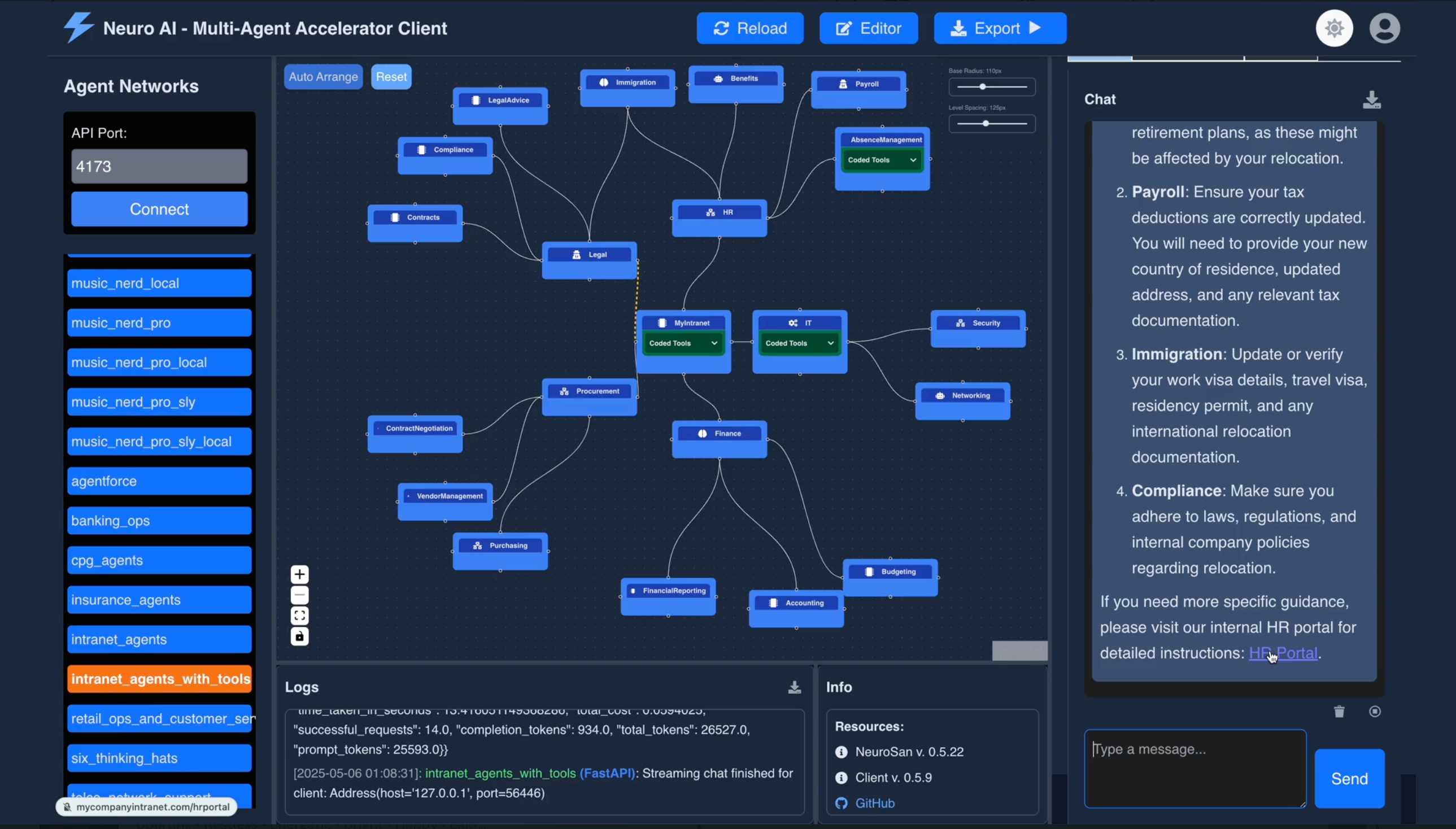
Powering Cognizant's OneCognizant intranet, this network connects employees to specialized agents for HR, IT, and workplace services, helping them find information, resolve requests, and access support through a unified experience.
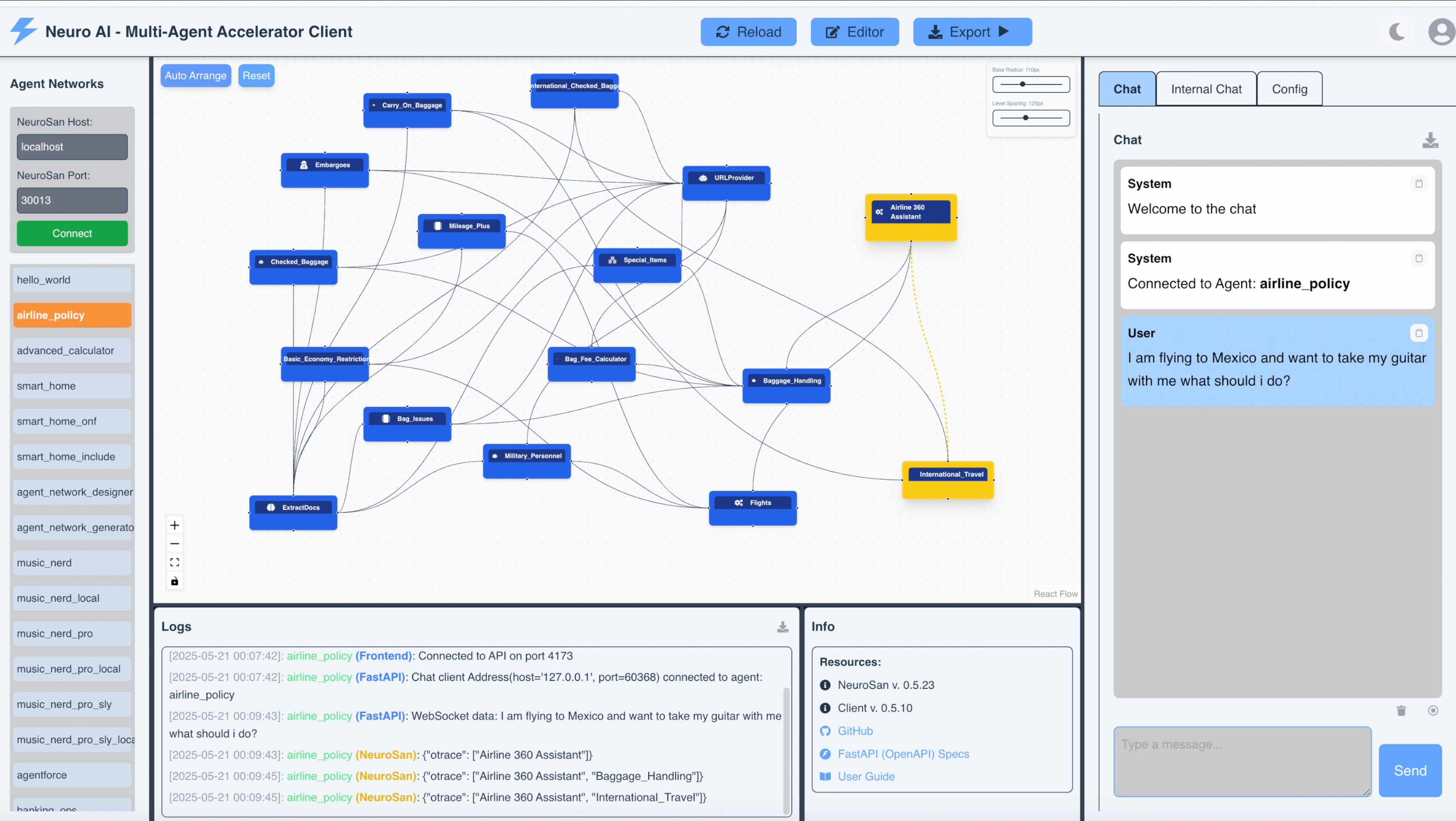
A network of specialized agents that helps travelers navigate airline policies, from baggage allowances and flight cancellations to refunds and other travel-related questions, delivering clear answers based on relevant policies.

GET STARTED
Ready to Build with Neuro San?
Build agent networks directly in your browser with your own API key, or install the open-source framework locally for full control over your development environment.
FAQ
Neuro San is an open-source, data-driven multi-agent framework developed by Cognizant AI Lab. It enables developers to build, connect, and orchestrate networks of specialized AI agents that collaborate, delegate tasks, and perform actions through external tools. Its configuration-driven approach makes it easier to design, test, and adapt multi-agent systems without hardcoding every interaction.
Yes! Neuro San is open-source and free to download, use, and customize under its applicable license. Developers can access the framework, example networks, and development tools on GitHub. While Neuro San itself is free, connected LLM providers, cloud infrastructure, and external services may have separate usage costs.
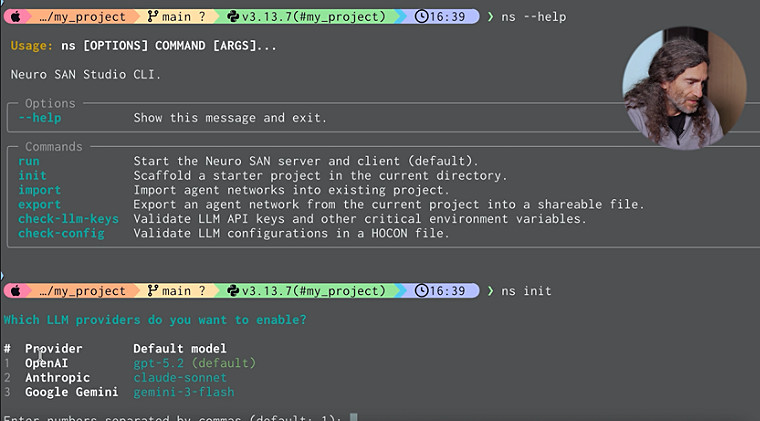
You can get started in two ways: launch Neuro San directly in your browser using a supported LLM API key, with no installation required, or install Neuro San Studio locally to build, run, and test agent networks. The local development environment provides example networks, configuration tools, and interfaces for interacting with agents.
For the hosted browser experience, you'll need an API key from a supported provider, including OpenAI, Anthropic, or Google Gemini. Local installations support additional model providers and configurations, including locally hosted models such as Ollama, which may not require a cloud API key. The credentials you need depend on the models and services you choose to connect.
Neuro San is the open-source framework that powers Cognizant Neuro® AI Multi-Agent Accelerator. The framework gives developers the tools to build, configure, and orchestrate agent networks, while the commercial Accelerator builds on this foundation with additional enterprise capabilities and services for deploying and managing multi-agent systems at scale.
Neuro San takes a configuration-driven approach to multi-agent development, defining agent networks in HOCON files rather than requiring their structure to be hardcoded in Python. Its AAOSA-based architecture enables decentralized agent collaboration and intelligent task routing, while sly_data provides a private channel for sharing sensitive information without exposing it in LLM prompts. Neuro San also includes tools for network generation, testing, and debugging.
Neuro San supports a range of LLM providers, including OpenAI, Anthropic, Google Gemini, Azure OpenAI, and locally hosted models through Ollama. Different agents within the same network can use different models, allowing developers to optimize for cost, latency, context requirements, and data privacy.
Yes. Neuro San supports integrations with MCP servers, APIs, databases, custom Python tools, and external agent ecosystems, including CrewAI, Agentforce, Agentspace, and LangChain tools. This allows developers to connect existing capabilities to new agent networks without replacing their current systems.
Multi-agent orchestration allows specialized AI agents to collaborate on complex tasks by dynamically delegating work and coordinating across roles. Unlike single-agent systems, multi-agent systems distribute responsibilities across specialized agents, enabling more modular, adaptable, and potentially more reliable systems through focused expertise, independent validation, and coordinated problem-solving.
AAOSA (Adaptive Agent-Oriented Software Architecture) is the decentralized coordination approach used by Neuro San. Rather than relying on a central controller, agents determine whether to handle a request themselves or delegate it to a more specialized agent. This enables intelligent routing, dynamic collaboration, and flexible agent networks without requiring developers to define every interaction in advance.
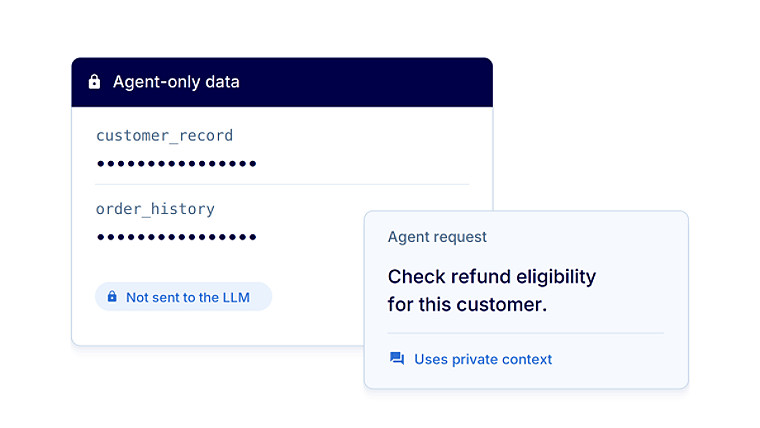
Neuro San uses sly_data, a private data channel that allows agents and coded tools to exchange sensitive information without including it in LLM prompts. Developers can configure which data is shared between agents and across network boundaries, helping protect credentials, customer records, and other sensitive information. Logging and tracing capabilities also provide visibility into agent interactions for debugging and oversight.
Neuro San offers a range of open-source development tools, including Neuro San Studio for building and managing agent networks, the Agent Network Designer for generating networks from natural-language prompts, and NSFlow for visualizing and interacting with agents. Developers can also use the command-line interface (CLI), along with testing, logging, and tracing tools to debug and validate agent behavior. Agent networks can be extended with MCP servers, APIs, custom Python tools, and integrations for web search, information retrieval, and code execution, including OpenAI and Anthropic tools, Firecrawl, DuckDuckGo, and Wikimedia Search.
Neuro San can run as a Python library or as a server, with deployment options spanning local environments, containers, and cloud infrastructure. It supports integration with external services, authentication and authorization mechanisms, and observability tools for monitoring agent behavior. For organizations seeking additional enterprise deployment capabilities and support, Cognizant offers the commercial Neuro AI Multi-Agent Accelerator and related services. Please complete this form.
Start Building With Neuro San
Interested in a commercial license for scaling agentic networks using our Neuro AI Multi-Agent Accelerator? Complete this form.