
















New frontiers,
new frictions
Mapping the DNA of AI adoption
Our global study of 10,000-plus workers reveals the hidden segments in the workforce—and $6 trillion in trapped productivity—behind AI's adoption gap.
Discover industry-specific solutions and expertise.
Solve your toughest A&D challenges with Belcan.
Ignite peak performance and efficiency in your business.
Reimagine your manufacturing competitive advantage.
Accelerate growth with customer-focused solutions.
Deepen customer loyalty, drive long-term relationships and boost profitability.
Meet customer demands for a digital, personalized online insurance experience—while reducing risk.
Digitally transform to empower a more intelligent, agile and high-performing enterprise.
Deep industry expertise to propel your business into the future.
Turning Agentic AI into governed enterprise value
Modernization that secures and enables enterprise AI
Real-time AI governance, security and trust at scale
Scaling sovereign enterprise intelligence
Maintain high integrity across the AI lifecycle.
Transforming workforces at the speed of AI
Operating layer for the enterprise AI
AI-powered business operations automation
AI insights to inspire enterprise transformation.
Uncover the $6 trillion in trapped AI potential hidden in the workforce.
Turn AI spending into real productivity gains by investing in workforce skilling.
Discover how to become a high AI performer—and realize billions in AI returns.
Explore the latest in AI in our newsletter released bimonthly.
Explore how our expertise can help you sense opportunities sooner and outpace change.
That friction, it turns out, is both widespread and consistent. Our research reveals that most of the workforce wants to use AI far more than current operational realities allow. Additionally, most are unhappy with the AI tools their organization makes available.
Further, while enterprises tend to roll out AI as if they are working with a single, generic employee, AI adoption varies greatly among different segments of the workforce. A one-size-fits-all deployment can be a key cause of friction, itself.
As part of our research series on closing the gap between AI's technical capabilities and achieving real-world results, we explored the role that workers themselves play in either speeding or slowing adoption.
By asking respondents detailed questions about their overall disposition toward technology, work and AI, we identified over 60 personas in the workforce today. These coalesced into seven archetypes, each with a distinctively different level of AI engagement and experience—and each with its own need for a specific intervention to boost AI adoption.
Across them all, several systemic AI adoption challenges emerged, each pointing to a specific, solvable problem that is currently suppressing trillions of dollars of potential value.
of employees record a positive Activation Gap, a measure of the gap between a worker’s AI aspirations and their actual use of it.
This represents a huge amount of untapped potential from employees who want to adopt AI but are unable to do so because of a wide range of factors, such as skills shortages, low access or concerns about outputs.
of employees are unsatisfied with the AI tools they’re given to use.
Across all archetypes, the vast majority of employees believe their current AI tools do not meet their needs.
of the workforce falls into just two archetypes: Stalwarts and Navigators.
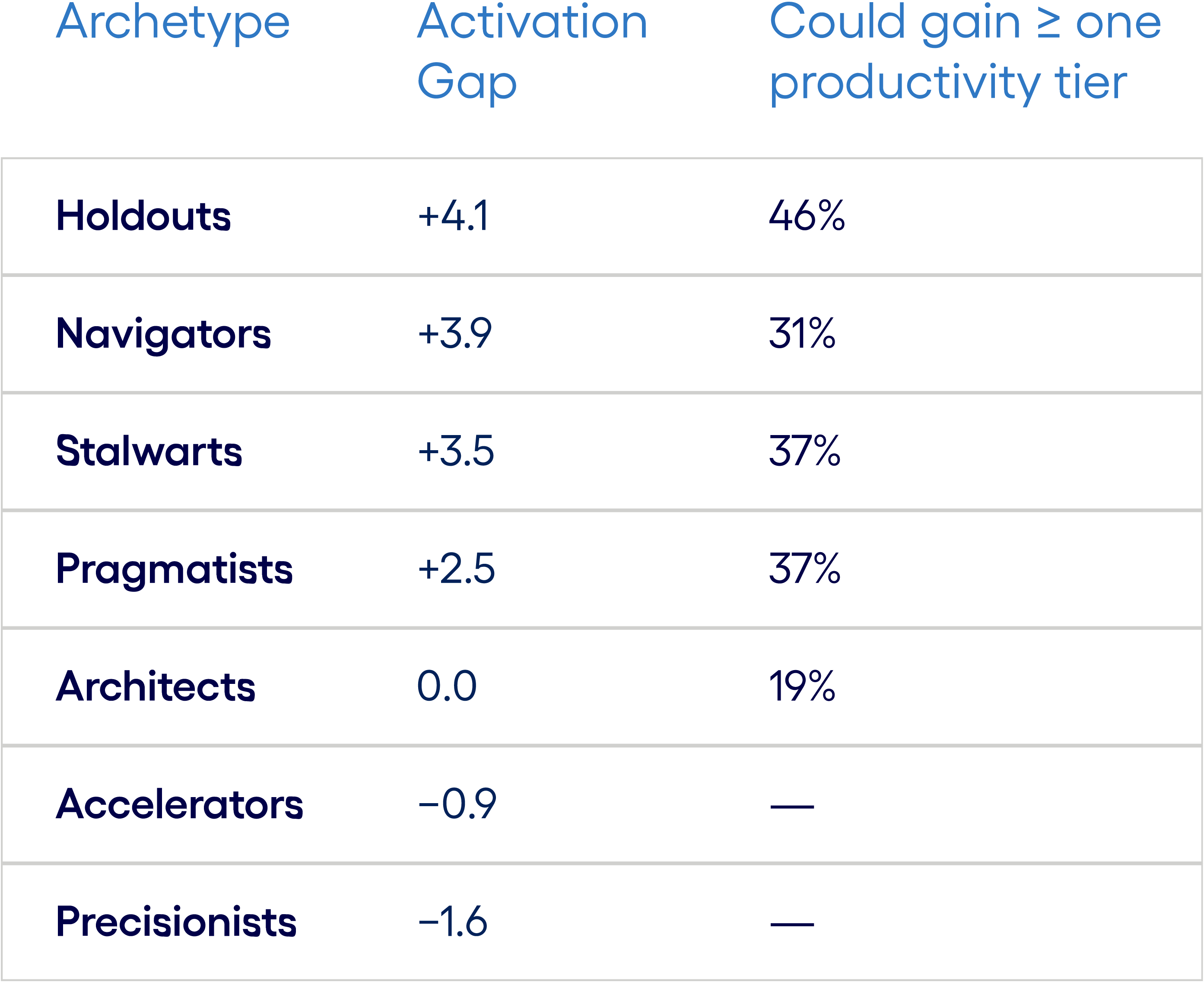
Because both of these groups also have the largest Activation Gaps, they are the most important for businesses to focus on. Even a uniform 5% rise in global labor productivity could contribute roughly $6 trillion to the world’s GDP.
To develop the archetypes, we first asked a series of detailed questions about respondents’ overall attitude toward technology (its risks and rewards) and work itself. We then modeled these insights against their experience with using AI.
To understand the dynamics within the archetypes, we created the Activation Quotient (AQ), which scores how engaged employees are with AI, and the Activation Gap (AG), which measures the distance between aspiration and action.
The figure below shows the seven archetypes that make up the modern workforce, ordered on the basis of their Activation Quotient.
The Activation Quotient assesses the degree to which employees are engaged with AI, based on their current use, future expectations, skill levels and response to their organization's operating conditions.
The Activation Quotient’s four building blocks are Action (what they are doing today), Aspiration (what they wish they could do), Ability (what they have access to) and Conditions (how aligned they are with their organization’s view of AI adoption).
An archetype that scores above the workforce average of 61 is more likely to adopt AI with the right supports in place. Archetypes with below-average scores will require more effort to be engaged.
Employee engagement is only half the story. To understand the ease of enabling the workforce and the potential gains of doing so, we created the Activation Gap, a metric that measures the distance between how much a worker aspires to use AI and how much they actually do. In effect, this represents how much trapped potential still sits at the employee level.
A positive Activation Gap value indicates untapped potential. A negative value means the group is already pushing the boundaries of AI adoption.
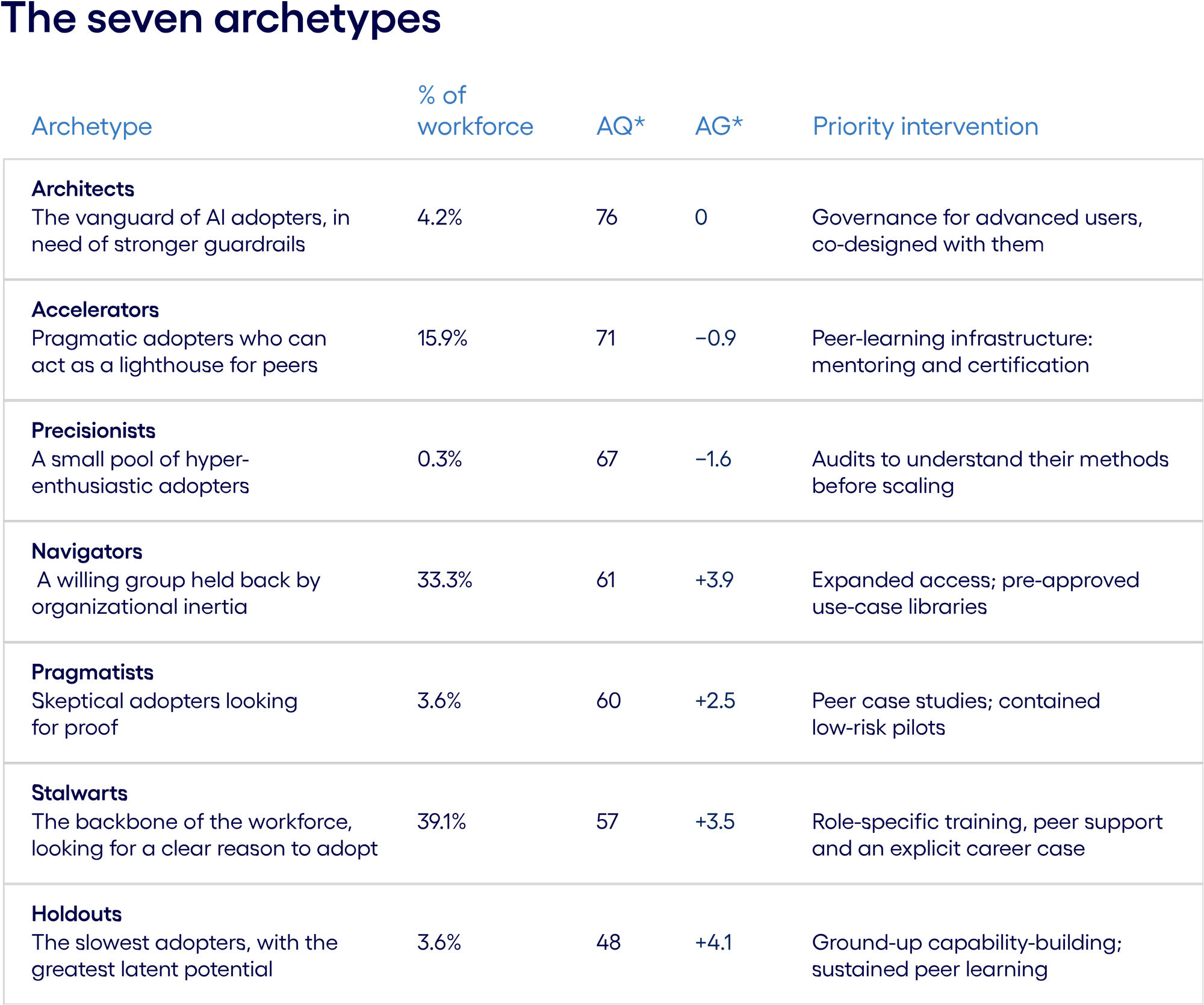
Figure 1
*Activation Quotient and Activation Gap
Note: For AQ, an archetype that scores above the workforce average of 61 is more likely to adopt AI. Archetypes with below-average scores will require more effort to be engaged.
Base: 10,000 workers in 10 geographies and multiple industries
Source: Cognizant Research

Figure 1
Note: For Activation Quotient, an archetype that scores above the workforce average of 61 is more likely to adopt AI. Archetypes with below-average scores will require more effort to be engaged.
Base: 10,000 workers in 10 geographies and multiple industries
Source: Cognizant Research
Each of the seven archetypes demands a tailored approach to AI adoption. Accelerators and Architects benefit from governance and knowledge capture aligned with their current practices. Precisionists require organizations to first understand their self-built solutions before scaling them. Navigators need access and permission, while Pragmatists are motivated by peer evidence in trusted contexts. Stalwarts require assurance and career relevance, while Holdouts need foundational skills that are consistently reinforced.
AI value is not in the technology itself but in the adoption of it. When there’s too much friction in adoption, there is less AI impact. What remains, then, is the strategy: a strategy that strives to resonate with the real workforce, which is a diverse one.
The archetypes in this report are the map, and the organizations that read it will be the ones that convert AI’s theoretical capability into realized productivity, one archetype at a time. Because a workforce that wants AI and an organization that can deliver it is the fastest way to realize AI value.
Please download the full report, which contains detailed archetype profiles and intervention frameworks.
Mary Brandel
Editor